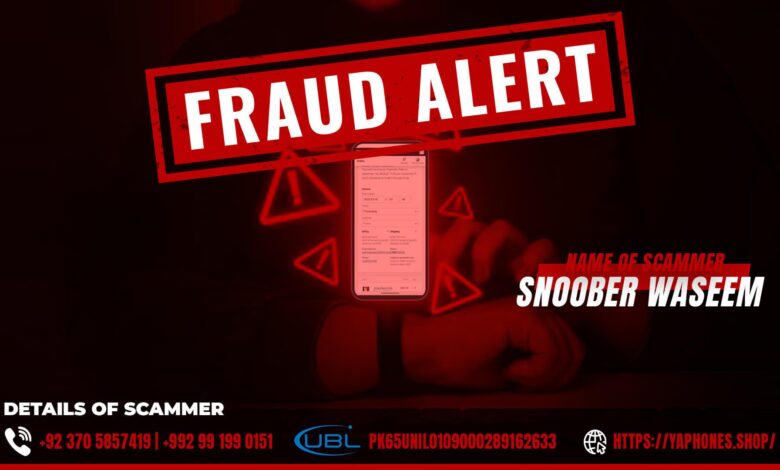
PayPal Scam Alert: Snoober Waseem and YaPhones.Shop Exposed in Real Case

Online payments are built on trust. Buyers trust platforms like PayPal to protect their money. Sellers trust payment systems to deliver funds fairly. Service providers trust that clients will act honestly. When that chain of trust breaks, the damage spreads far beyond a single transaction.
This article documents a real case involving Snoober Waseem and the e-commerce website YaPhones.Shop, where misuse of PayPal’s dispute system resulted in financial loss for a third-party payment service provider. What makes this case important is not just the money involved, but the method used and the group that ultimately paid the price.
This is not speculation. It is a documented experience that highlights how online scams can operate quietly, how intermediaries can be exploited, and why stronger awareness is needed across the digital payments ecosystem.
Why This Case Matters
Most PayPal scam stories focus on buyers who lose money or sellers whose accounts are limited. This case is different. It shows how payment facilitators, companies that help others receive international payments, can become the unintended victims of e-commerce fraud.
These companies do not sell products. They do not ship items. They simply move money. Yet, under PayPal’s structure, they often carry full financial responsibility when disputes arise.
That is exactly what happened here.
Background: The Role of a Payment Service Provider
Companies like JahaSoft Ltd exist to help freelancers and small businesses receive international payments. Many individuals around the world cannot directly withdraw PayPal funds into their local banks due to regional restrictions or technical barriers.
To solve this, payment service providers:
Receive PayPal payments on behalf of clients
Deduct a small service fee
Transfer the remaining balance to the client’s local bank
This system works smoothly when all parties act honestly. Problems begin when an e-commerce seller uses the system to withdraw funds quickly and leaves disputes unresolved.
Introduction to YaPhones.Shop
YaPhones.Shop presented itself as an online mobile phone retailer. The site advertised popular and high-end smartphones at prices far lower than market value. For buyers, the offers looked almost too good to ignore.
The store relied heavily on social media advertising, particularly TikTok. Short, eye-catching videos promoted limited-time deals and deep discounts. This approach generated fast traffic and a high volume of orders in a short period.
Buyers placed orders and paid using PayPal, trusting buyer protection to cover them if something went wrong.
The Individual Behind the Transactions
The transactions were linked to Snoober Waseem, who received the withdrawn funds into a local bank account after payments were processed through PayPal.
At the time, there was no immediate reason to believe the arrangement would result in disputes. Payments came in normally. Communication initially appeared cooperative. Funds were transferred according to the agreed service terms.
Then the pattern changed.
How the Transactions Unfolded
The timeline of events followed a familiar but dangerous structure.
First, PayPal payments were received from buyers purchasing phones through YaPhones.Shop. These payments appeared legitimate and referenced product orders.
Second, the payment service provider transferred the funds, after fees, to the client’s bank account. Transfers were successful and confirmed.
Third, after a delay, PayPal disputes began to appear.
This delay is critical. It allowed the funds to leave PayPal before any complaints surfaced.
The Dispute Phase
Buyers began reporting that they had not received their phones. Some stated that tracking information was never provided. Others said communication stopped entirely after payment.
These buyers filed disputes with PayPal, claiming non-delivery or item not received.
From PayPal’s perspective, these were valid buyer protection claims.
Why PayPal Refunded Buyers
PayPal requires sellers to provide proof of delivery to win disputes related to physical goods. In this case, the payment service provider was not the seller and had no access to shipping details.
Without proof of delivery, PayPal ruled in favor of buyers.
Refunds were issued.
Who Paid for the Refunds
This is the core issue.
PayPal does not reverse funds from a seller’s local bank account once they have been withdrawn. Instead, refunds are deducted from the PayPal account that originally received the payments.
That account belonged to the payment service provider.
As a result:
Buyers received full refunds
The seller kept the withdrawn funds
The intermediary absorbed the losses
This left the service provider financially exposed, despite having no role in the alleged fraud.
Reported Banking and Contact Information
For documentation and transparency, the following details were used during the transactions:
Reported phone numbers:
+92 370 5857419
+992 99 199 0151
Bank details:
United Bank Limited (UBL)
IBAN: PK65UNIL0109000289162633
Account Title: SNOOBER WASEEM
These details are shared to help others identify connections or recognize similar cases.
The Role of Social Media Ads in the Scheme
Social media platforms play a major role in modern ecommerce scams. TikTok ads are fast, visual, and reach massive audiences in hours. They are ideal for promoting impulse purchases.
In this case, discounted phone ads created urgency and excitement. Buyers acted quickly. Few questioned the pricing. Many trusted PayPal to protect them.
By the time complaints emerged, ads had already done their job.
Why Payment Intermediaries Are Vulnerable
Payment facilitators sit in a risky position.
They are responsible for PayPal
They are separate from the seller
They have no control over shipping
They have limited power once funds are released
This makes them an easy target in delayed-dispute scams. Sellers withdraw funds quickly. Disputes come later. The intermediary pays the price.
Warning Signs That Became Clear Later
After reviewing the situation, several red flags stood out:
Prices far below market value
High-value products sold rapidly
No visible fulfillment or logistics setup
Quick withdrawal of funds
Delayed buyer complaints
Each sign alone might be explainable. Together, they form a pattern that payment service providers must take seriously.
Impact Beyond Financial Loss
The damage extended beyond money.
Time was spent responding to PayPal cases
Staff had to handle angry buyers despite not selling anything
Account health was temporarily affected
Internal processes had to be rewritten
Trust in client screening was shaken
These hidden costs often exceed the financial loss itself.
Why This Case Is Being Made Public
Cases like this often stay private. Companies absorb losses quietly and move on. That silence allows the same methods to be reused elsewhere.
This case is shared publicly to:
Warn payment facilitators
Educate freelancers and small agencies
Encourage stronger verification practices
Exposes how dispute systems can be misused
Awareness is one of the few defenses available.
Changes Implemented After the Incident
Following this experience, strict changes were made:
Longer holding periods for e-commerce clients
Lower withdrawal limits
Additional identity and business verification
Stricter approval for high-risk products
Continuous dispute monitoring
These measures protect the service provider but also improve overall system integrity.
Advice for Payment Service Providers
If your business handles funds for others, this case offers important lessons:
Never assume e-commerce clients are low-risk
Delay fund release when physical goods are involved
Treat deep discounts as a warning sign
Limit exposure per client
Prepare for disputes before they happen
Trust must be backed by controls.
Advice for Online Buyers
Buyers should also learn from this case.
Unrealistically low prices often come with hidden costs
Social media ads should not replace research
PayPal protection is helpful, but prevention is better
Check independent reviews before buying
Being cautious saves time and frustration.
Final Reflection
The case involving Snoober Waseem and YaPhones.Shop demonstrates how PayPal’s dispute system, while designed to protect buyers, can be misused in ways that harm third parties.
Payment facilitators play an important role in the global digital economy. Without better awareness and safeguards, they remain vulnerable to the same pattern repeating under different names and websites.
Publishing this experience on TechieTalks is about more than one case. It is about recognizing how modern scams operate and ensuring fewer companies are caught in the middle.
If you have encountered similar behavior or have information related to this case, sharing it may help prevent further losses.
Transparency is not about accusation. It is about accountability.
